Blog
Building in Detroit Motor City
October 10th, 2025

The Future of Industrial Design

Reflections from IDC Detroit

I recently attended my first International Design Conference (IDC) and Education Symposium in Detroit, where designers, educators, and futurists gathered to explore the past, present, and future of industrial design. The event was packed with overlapping workshops, panel discussions, presentations, fireside chats, and keynote speeches. Choosing how to spend my time wisely was a challenge, but here are some of the high points and insights I’d like to share.

What’s Shaping the Future of Industrial Design

Manufacturing & Location

The current tariff situation is encouraging a push to bring manufacturing back to the U.S. This shift creates an opportunity for designers and manufacturers to forge closer, more beneficial relationships, enhancing collaboration and product outcomes.

AI & The “Double Boom”

The industry is currently experiencing a “double boom.” The emergence of AI is driving a “physical boom” in product design, intended to match and complement the ongoing “AI boom.” Companies are actively focusing on creating physical embodiments to make AI more tangible and accessible in our daily lives.

Agencies Shifting Focus

Teague offered an insightful retrospective on their history with projects like Pringles and Boeing. They emphasized the importance of a design firm’s internal context to meet evolving market demands. They are now choosing to shift focus away from consumer electronics to creating the physical embodiments necessary for the software and AI boom.

Design Is Still Human

A powerful message from Patty Moore emphasized three core virtues for designers: courage, confidence, and conviction.

Without designers and their vision to see through the unknown, companies tend to default to safe, incremental, known solutions. Designers take the unknown, make it real, and turn the unbelievable into the believable. In the face of global uncertainties, these virtues can serve as a guiding light. As Buckminster Fuller said, “We are meant to be architects of the future, not victims of the past.”
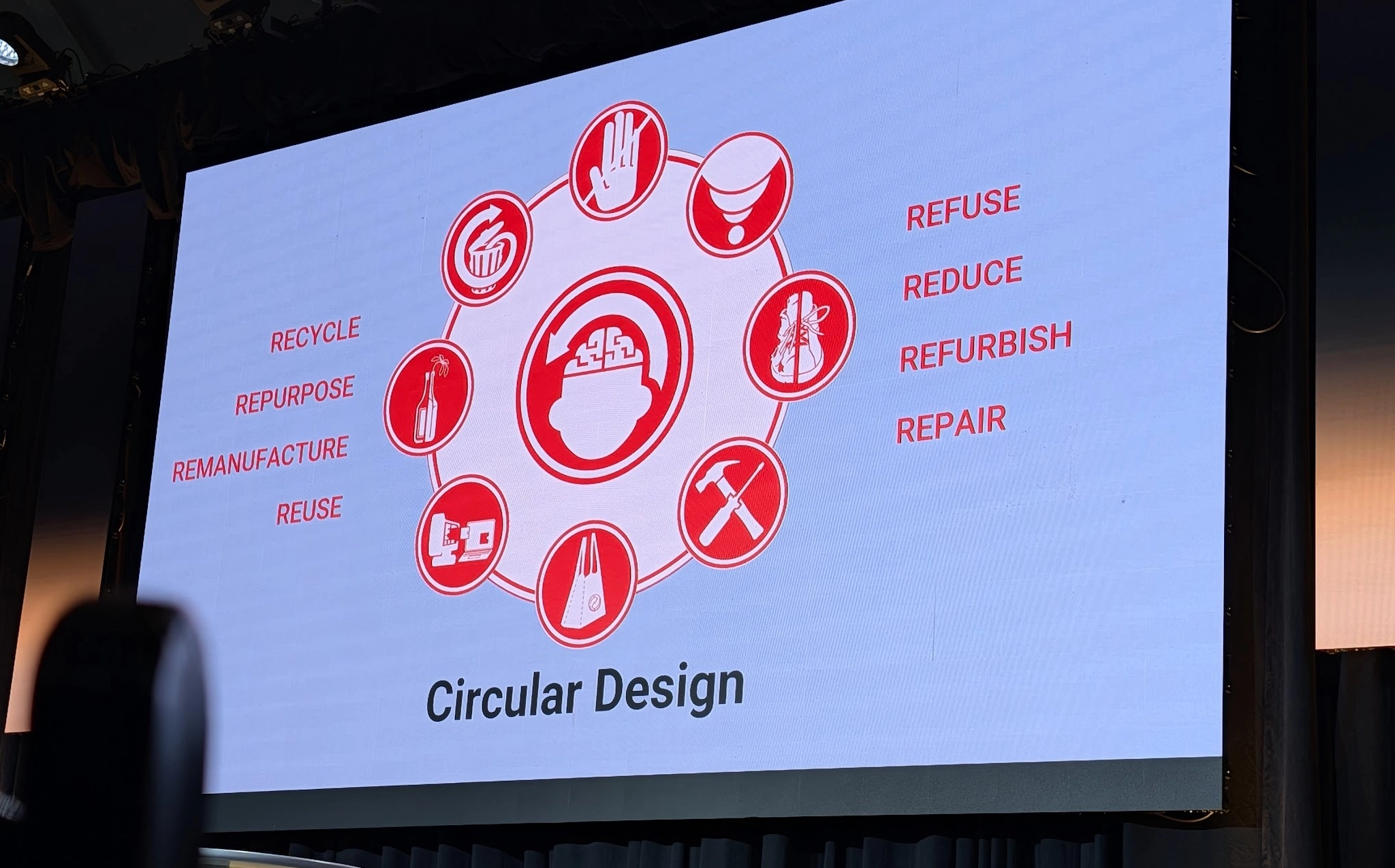
Sustainability Evolves: From 3 R’s to 9 R’s and Beyond

The familiar mantra of “reduce, reuse, recycle” is no longer enough. The concept of sustainability can now be expanded into the 9 R’s:

  1. Rethink: Consider all impacts on creating, owning, and using new products and packaging
  2. Refuse: Decline to use materials or manufacture new products when satisfactory solutions exist
  3. Reduce: Decrease the use of raw materials in new products and packaging
  4. Repair: Repairing and maintaining existing products to extend their useful life
  5. Reuse: Use of products by another owner for the same purpose as originally designed
  6. Refurbish: Restoring and improving products to their original condition
  7. Remanufacture: Use parts from discarded products to remake them for their original purpose
  8. Repurpose: Use discarded products or parts to make new ones for A different function
  9. Recycle: Process materials to produce the highest grade of quality feasible for reuse

For designers, these aren’t just environmental checklists; they’re prompts for innovation. Each “R” invites us to imagine smarter ways to design, make, and use.

Sustainability is also being redefined through the lens of Environmental, Social, and Governance (ESG)—and the evolution from minimizing harm to creating net positive impact:

  • 1.0 – Minimizing negative impact
  • 2.0 – Striving for neutrality or zero harm
  • 3.0 – Creating net positive outcomes
  • 4.0 – Reconfiguring systems so people and planet thrive

As designers, we have an essential role to play in moving the world toward Sustainability 4.0—shifting from doing less harm to enabling good.

Circular Design 9 Rs of Sustainability

AI in Design: A New Partner in the Process

The effects of AI on the industry were a major theme, with several presenters discussing its role in the design process. A key takeaway was that AI is a tool, and you must start with a clear vision to direct its outcome.

Some key takeaways stood out:

  • Not a Time Saver (Necessarily): Contrary to popular belief, AI doesn’t automatically save time. Instead, it allows for a higher volume of high-quality ideas to be generated within the same timeframe.
  • Context is King. Large Language Models (LLMs) connect ideas through probabilistic patterns—but only designers can supply the human context and intent that give meaning to those connections.
  • AI Enhances Ideation. It helps teams visualize attributes, materials, and user experiences early in the process—bringing imagination to life in new ways.

Several tools are rapidly gaining traction, including Vizcom, Midjourney, Photoshop’s new generative features, New Arc, and ChatGPT. Each offers a glimpse into how design workflows may soon blend human intuition with machine learning.

Closing Reflection

The IDC wasn’t just a look back; it was a clear call to action. From bringing manufacturing home to embracing the 9 R’s of sustainability, the future of industrial design demands that we move beyond simply reacting to becoming the architects of systemic change. The tools—whether AI or the timeless virtues of courage and conviction—are in our hands. Now, we must build.

Let’s Start with a Conversation

For manufacturers and innovation teams navigating change, a discovery call with our team can clarify your needs—and reveal opportunities for growth.