Jared:
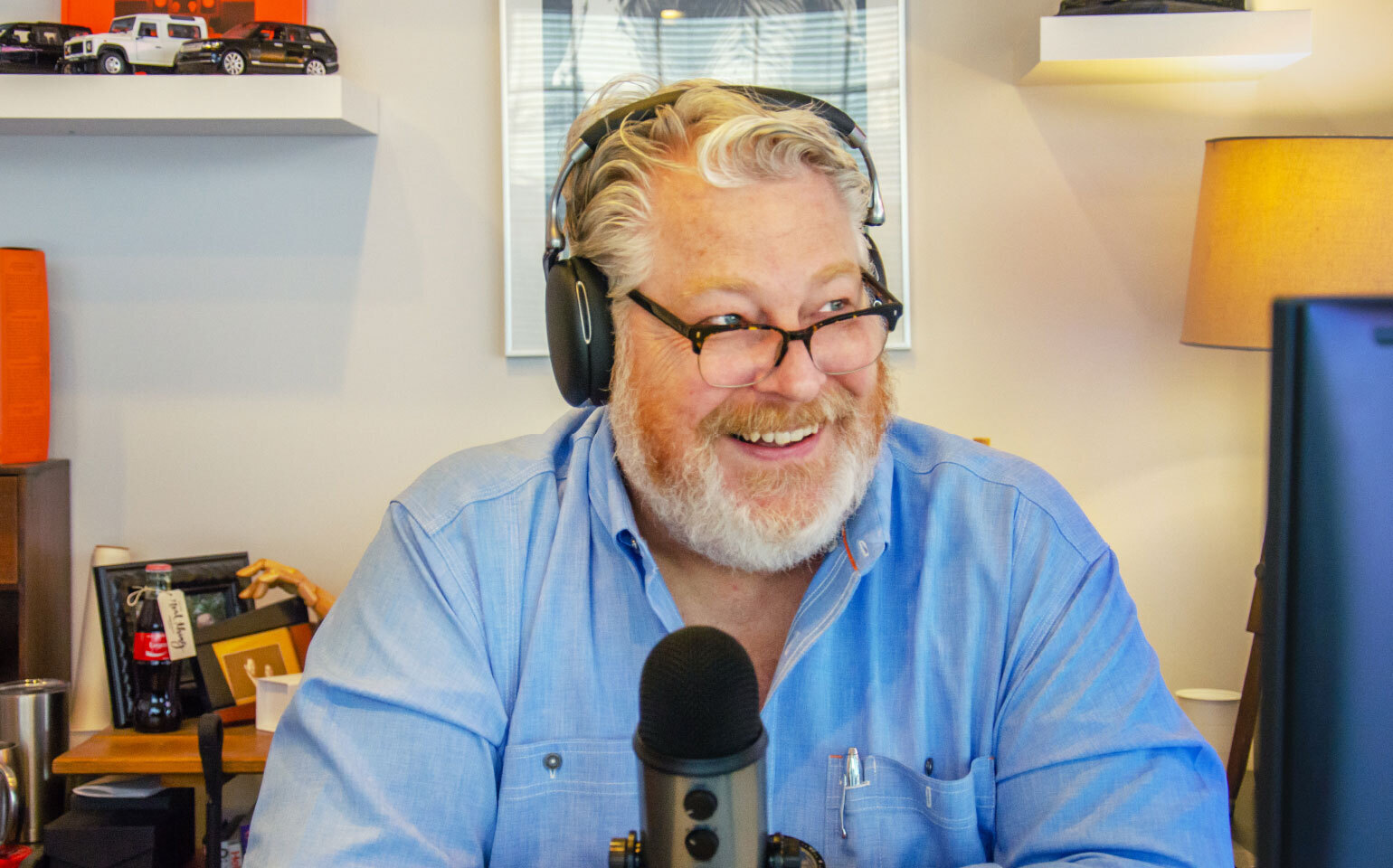
Welcome to The Hive Life, where we pull back the curtain on Spiracle Media, a company based in Charlotte, North Carolina, with a team of former journalists that create beautiful, impactful stories that connect with your audience. Thanks for joining us for another episode of The Hive Life podcast. I’m Jared Latch alongside Tim Bares. We welcome our guest for this installment, Jamey Boiter, of The Bolt Group. He is a principal and chief operating officer. Jamey, it’s great to see you.
Jamey:
Jared, thank you. It’s great to be here.
From Architecture to Design
Jared:
We know where you are today in terms of your professional life, and it’s hard to determine that early on, as we know when people are trying to figure out what direction they want to go. I know you initially wanted to be an architect, but what changed your mind early on?
Jamey:
My mentor in college, a college professor. I took my first graphic design course and fell in love with the idea of communicating visually and verbally. And at that point, it was pretty easy for me to say, okay, I’m going to be a graphic designer. And my professor, Tom McPeek, he was like, no, not if you stay here, you’re not. And so we went through about a year of that back and forth, and he finally convinced me to transfer to design school when he said he was retiring. And that was it. But he had been an art director for one of the largest CBS affiliates in Kansas, Kansas City. And he had a copy of the CBS brand standards from the 60s sometime. When he showed that to me, it was like, okay, that’s what I want to do.
What BOLTGROUP Does
Jared:
So, when you talk about the BOLTGROUP and working in brand experience, in the simplest terms, how do you describe what you guys do?
Jamey:
We’re a design innovation firm, plain and simple. We’re uniquely focused on implementing turnkey strategy through to implementation in four areas:
- Brand
- Product design
- Digital, UI / UX
- Experience service design
Building Kobalt and Working in Tools & Durable Goods With a Detour into Retail Fashion
Jared:
Across the board in terms of your partners or clients, does it vary, or do you guys play more in one industry opposed to others?
Jamey:
We’ve had moments where we’ve had vertical focus. From time to time, you get one client, you get another client, and [then] you get another client. But we’ve had a lot of work in manufacturers of durable products that sell in home centers. We had a relationship with Lowe’s years ago. We actually created the Kobalt Tool brand and created that initial line of tools, the visual brand language for that, rolled that out. Then we worked with Ryobi and other tool companies, outdoor power equipment.
But we’ve also done retail fashion, men’s fashion. PVH, Phillips Van Heusen was a client of ours for probably 25 years. We worked on various brands inside their portfolio, IZOD being one that we did a lot of work with. Everything from store design, fixtures, communications, all the way out to getting involved with them and helping them get into IndyCar racing. You never know where it’s going to lead.
Jared:
Kobalt and Ryobi, those are two power tools I have in my garage that I use every week. So, that’s pretty cool.
We’ve had the chance to have beers a couple of times. You’re really good at telling stories. Is there one of these projects from all of these different types of companies you’ve worked with that jumps out to you that you really love?
Jamey:
There are quite a few. And over the past 30-something years now, I would say some of the fun work that we did were a lot of photo shoots that we did with PVH where we would be off to exotic places. Working really hard all day long, shooting big hours, big days, and then crashing at night.
But I guess just bringing a brand like Kobalt to life is probably one of the most fun experiences that any designer can have. To start with a white sheet of paper and have them say, let’s go do the research and find out whether or not this hypothesis can even be proven, and then to look into the market and say, yeah, we can create this and there’s a market for it. There’s a gap, and here’s what we need to do. Then from there, create it all the way to the point of having it merchandised and then having it launched, and then sit back and 20-something years later, it’s a multi-billion dollar brand.
The Power of Long-Term Relationships
Jared:
When you work with people for 20-plus years, it’s really relationships that have to drive that. I mean, how important is that to your business continuing to churn like you guys have been?
Jamey:
Relationships are everything. If we look at our client list, it’s not super deep because we’ve had extraordinary relationships at all levels. We’ve got clients that are currently on their fourth or fifth company. We started working with them when they were a marketing manager, a mid-level marketing manager, and now they’re CMO or CEO of a corporation somewhere else. But they brought us back every time they would move, and they would analyze what was going on or what wasn’t going on inside their organization and pick up the phone and say, Jamey, I need your help.
Jared:
I know you guys are headquartered here in Charlotte, started here in Charlotte, correct?
Jamey:
Yes.
How a Charlotte Firm Built a National Client Base
Jared:
But most of your clients are not in Charlotte or a big portion of them are not. How did that happen and how did you diversify your client portfolio in that way?
Jamey:
I think a lot of it goes back to what we do. If you think about product innovation as a design firm, brand experience work that we did, both B2B and B2C, we began to build a reputation pretty early on. We were being called in from different places. But again, it’s that migration of the marketing manager that begins to move up. They move across to the West coast. Then all of a sudden they give you a call and say, you guys want to do some work over here, or they’re in Toronto now. So, now we’re working internationally. That’s how a lot of it developed.
Also where those companies were; we got involved with PVH, through a relationship. I had developed a relationship with Mike Kelly, who is now the CMO for Heritage Brands at PVH. Mike had come down to Charlotte, to try to save Pick ‘N Pay; they were in chapter 11 and he came to town. And the first thing he asked them was, I need a design firm. Do you guys know anybody? They said, why don’t you call these guys over at BOLTGROUP? So, we had a meeting. I had a meeting with Mike the next day, started at about 11:30 in the morning. We finished up at Frankie’s—no longer exists—when they closed it and knocked us out. We had a stack of napkins we’d been drawing on all day. And that started the relationship. Once his work was finished here in Charlotte, he immediately went to work at PVH. He was there maybe a week and he called me, and I was in New York. That started a 20-something year relationship.
Jared:
Frankie’s, you mentioned that. That was the first official date spot for me and my wife.
Jamey:
It was a favorite spot for my father-in-law and my wife to go on, of all places, on Christmas Eve when they would go out and do their last minute shopping. Joe would say, let’s go to Frankie’s. That was a lot of fun. But with Mike, we went from having just PVH to then pretty soon having a stable of nine or 10 retail fashion clients. It led to us opening an office in New York, which we had for about seven and a half years. I commuted back and forth, and then we put a team up there: creative director, account team, and a couple of designers.
Navigating the Pandemic
Jared:
How has the pandemic affected you guys?
Jamey:
Knock on wood, we’ve gotten through pretty good. I’d say we went into it really well. We were positioned well. We had a heavy workload when we first went in. And so we shut the doors on the office for the most part. And we’re just now having folks come back in on a fairly regular basis. We kept the shop open. We’ve got a couple of 3D printers and so industrial designers or our EMEs would be in there working on prototypes or something like that. But usually it was just one or two in the office, but we’re very fortunate that we made it through the summer.
We had several clients who didn’t go away, but they pulled over to the curb and parked and said, we’re with you and let us know and we’re going to hang in there. And their business fortunately kept going, kept percolating, and so we’re seeing that come back right now. We’re picking up where some of those clients have called us back and said, okay, we’ve got some work here at the fourth quarter we need to try and crash on and get ready for 2021. So, we’re looking pretty good for next year.
Jared:
And you mentioned as we sat down, as if we needed extra wrinkles in the year, is that the building you’ve been in for 25 years, you’ve only got so much time to stay there because it’s been sold. But besides that is the design elements now in the planning that you’re thinking about, which is quite interesting.
Jamey:
That’s the fun part. It’s a double-edged sword. We’ve been in our space for almost 24 years. And so it’s all going to be new. And with our design team working from home, we figured it out pretty quickly that we could work from home. We could innovate. We could have workshop sessions, brain writing sessions. Zoom has become our best friend now. We’ve got some interactive whiteboard work that we’re doing. So, now we can work with our clients that way and can actually do an innovation session virtually, and it’s gotten pretty good.
In consideration of that, in our next space, do we need as much as we did? I know a lot of folks are thinking about that. There’s a lot of space uptown that’s probably going to be [empty] a while before it gets filled. We’re thinking about it hard; where’s our focus areas? Where’s our co-lab? Where’s our common space? Where’s our shop? Does it have to be what it has to be, right?
Jared:
Have you gotten a sense from your team members? Is there a yearning to come back or are they comfortable where they are?
Jamey:
Both. We’ve talked about it every Friday. We have a virtual happy hour and one week we’ll do our project list across the board. So, everybody knows what’s going on. Then we’ll have staff meeting the next week, but we always end with a good 45 minutes-an hour happy hour that we just kick it back and make sure everybody’s doing okay. What their plans are for the weekend, that kind of thing. But in conversations, we’ve figured out that there’s a high likelihood that one or two days a week that I can fully expect that some folks aren’t just aren’t going to be there, which is okay. They’re professionals; we hire them to be professionals. They know how to get the work done and they know what the deadlines are and they know when to ask for help. From that perspective, we’ve learned a lot.
Tim:
Does that open the space for talent? I mean, because the fact that they don’t have to physically be in the office anymore, can you hire somebody in Seattle, and can they now be working for the BOLTGROUP?
Jamey:
Potentially. We’ve done that in the past. We tried to design our business in a flexible way where we had our core talent in-house But then we try to surround ourselves with really good strategic partners like you guys, for instance, where at any given moment we could flex up 30% if we needed to. The way we’ve done it in the past is, we’ve had folks that were on the West Coast. Or we’ve had one of my designers from several years ago, Mandy Smith. Mandy and her husband, Mike, moved to Austin because they just wanted that Austin scene and were ready to do something different. She ended up at Razorfish and then she went out on her own. She was part of our culture and it was already baked in. We continued to work with Mandy and it was like she was next door; we’ve been really fortunate that we’ve had that situation a few times with folks that have had family changes, growing their family, or they need to take a step back. And we’ve been able to be real flexible with that. But Tim, to your point, it sure opens up opportunities for down the road. We’ve always worked with other resources, photographers and that sort of thing, that might be in Florida, they might be in Hawaii, New York for sure.
Aligning Business, Brand, and Design
Tim:
Now, what you embrace is the collision of business, brand, and design. How do you make sure those three elements are aligned because they’re all significant, but they have to have a synergy between them?
Jamey:
We believe strongly in building a brand ecosystem, and that’s really about communicating the brand from the inside out—the importance of starting with purpose and understanding the purpose of the brand. Why does it exist? Then as we begin to build out that strategy, looking at the business goals and how do we align the business goals with the brand strategy that’s agile enough to create that trajectory.
Once the trajectory is started and you begin to move along that path of designing these customer experiences, if you will, internally as well as externally, you can create that culture. You can basically design that culture that you start to create behavior and that behavior influences the brand and the brand drives the business.
You’ve got in-facing communication and out-facing communication. We believe it ought to be the same—how you do it, your tone, the manner, the voice, everything, so that you get that culture right internally. Then the communication you’re having externally becomes intelligent conversation with your consumer as opposed to you’re trying to sell them something. And it’s totally authentic.
We talk a lot about, I pick up acronyms, probably too much, but we’ve got trust, transparency, authenticity, simplicity, and clarity. If you bake those in along the way and follow the task, then you’re going to get that at the end.
“Innovations That Matter”
Tim:
So, you guys have an internal video series. We obviously love to talk video here. It’s called “Innovations That Matter”. What do you guys focus on with that?
Jamey:
That was born out of COVID. Very simply, we were seeing in the early days, we actually had a few people call us, being a product design firm as well as a brand firm. We had folks call us up and say, I’m thinking about this. Has anybody ever done this? Let’s do our research and find out and see where we could help.
At the same time, our designers are designers. So, they’re sitting back watching TV every night or doing whatever, or not walking down the street because they’re sequestered and they’re thinking, if I only had this. As we began to look on the internet, we were seeing innovation that mattered happen just overnight. Things like the young kid that created the piece for the masks to give you greater comfort, and it’s brilliant, and he created it on a 3D printer.
We began to think about from our perspective as designers and engineers and strategists, how do we look at it objectively and impart our sense of how we think this might work? We gauge things on innovation, scale, ability to scale, those kinds of things. It’s been a lot of fun, number one, to do it, but we’ve gotten great feedback from some of the folks that we featured.
Tim:
Is it that innovation that you’re exposed to? And I guess the new opportunities that you find with these clients that keep you going from a business perspective and fuel your energy and excitement.
Empathy as a Design Advantage
Jamey:
Totally. We joke around a lot and it’s never the same two days in a row at BOLTGROUP. It’s not while even when we’re in a program; we just started a brand program a couple of days ago and we’re doing it remotely.
We’re in the research and strategy development part right now, and it’s a lot of fun. We’re back into a market that we had not been in for a year or so. We’re learning new things, and things are coming up, but we’ve learned new things along the way. How are we applying that? The thing I always talk to my designers about is never forget. Yes, you’re a designer, you’re a strategist, but you’re also a consumer. So, think about it from the consumer’s perspective, and what drives our business is empathy—really trying to understand.
RS Wurman, who was known as the father of information architecture; he’s out of Philadelphia. He wrote all these books for cities and he has a quote that says to communicate you must first understand what it’s like not to understand. That’s empathy. That’s really putting yourself in your consumer or your customer shoes, getting to their place so that you can gain the insights needed and then be able to innovate from there.
Look at how it’s framed up and reframe it. It’s the only way to effectively message if you look at it that way because it has to be received. That’s the only way to do that. Again, that’s where authenticity bleeds through, when you’re talking about truth and transparency and authenticity, that’s where it comes from.
Rapid Fire: Getting to Know Jamey
Jared:
All right. So, this is the fun part of the interview. We get a little bit of rapid fire. We just throw out some quick questions asking easy stuff, but just want to get a little bit more about you and you as a person, too.
First one is what motivates you?
Jamey:
Oh, my family, for sure. And also my staff, they drive me.
Jared / Tim:
Hobby or fun fact that others wouldn’t know about you.
Jamey:
Hobby, maybe in my garage right now because we moved them. I probably have 75, 80 12-inch GI Joe’s.
Jared / Tim:
I like that. That’s something I didn’t think I’d hear during the course of this.
Jamey:
Exactly. I mean, that makes me smile. I was a child of the 60s and the late 60s. That was my era when I was a kid was this 12-inch action figure. They had a resurgent a few years ago and I was fortunate I was in on it and able to collect a few.
Jared / Tim:
Are they all still in the boxes, original packaging?
Jamey:
I do have most of the boxes and packaging. I’ve only got one or two originals. A lot of them are reproductions. We had them on display and then we’ve got boxes and stuff.
Jared / Tim:
That’s awesome. What’s something you’ve discovered about yourself during the pandemic that you weren’t aware of before?
Jamey:
Working from home is a little harder for me because I’ve got two college age sons that are at school from home, and my wife’s at home and it can be a little bit of a distraction. There’s the “honey do” list that you want to do, but then just being at home and being with family, it’s like, wait, I need to get in the car, go to Starbucks, come in a different door, and go to work.
Jared / Tim:
What type of music is the go-to on your playlist?
Jamey:
I knew you were going to ask that. If you look at my playlist, I am my own enigma. I love music and at the heart of me, and I think that’s one of the reasons that I guess we do what we do. Music is so much about the human condition. Right this minute, Katherine turned me on to Nathaniel Rateliff and he’s just doing it for me right now. Wu-Tang Clan is still there, and I think about the dichotomy of that and then stuck in the middle is Darius Rucker and Natalie Merchant. They’re all there. I mean, even Diana Krall.
Jared / Tim:
I appreciate the cross genre music. I’m the same way. I know I get to play some classic rock in there sometime, move to country. I mean, it’s all over the map.
Jamey, thank you so much. We really appreciate you coming in and I’ve really enjoyed the conversation.
Jamey:
Guys, it’s been a pleasure. I really enjoyed it. I appreciate what you guys are doing for the community, the design community, the creative community. Keep it up.
Jared:
A reminder for those listening, you can check out the team at BOLTGROUP by heading to boltgroup.com and you can find out more about us, Spiracle Media, by visiting spiraclebuzz.com. There you can find a number of things, including our resources tab, which leads you to more episodes of the Hive Life podcast, as well as other helpful information.
For Jamey Boiter and Tim Bare, I’m Jared Latch. Thanks so much for listening and so long for now.