
White Paper
cracked concrete foundation
December 5th, 2025

The Trust Dividend: Building Client-Centered Brand Strategy

Part 1 of 2

Why Your Profit Problem Is Really a Brand Problem

A few years ago, a manufacturing client approached us with what seemed like a straightforward challenge. Sales had flattened. Market share was slipping. Their diagnosis: the packaging needed a refresh.

We spent weeks not designing anything.

Instead, we talked to their customers. We mapped the buyer’s journey. We studied their competitive landscape. And we discovered something that had nothing to do with packaging: the company had fragmented its brand architecture across dozens of sub-labels (35), each with its own look, voice, and promise. Customers were confused. Retailers couldn’t tell the story. Internal teams were working against each other without realizing it.

The packaging wasn’t the problem. Trust was.

By consolidating their brand architecture, aligning their business and product strategies, and creating a single, coherent narrative, we not only improved their market position but also enhanced their overall brand identity. We increased their company valuation by 30% when they sold the company to the highest bidder.

That’s the power of trust built on truth.

At BOLTGROUP, we’ve spent 40 years learning one essential lesson: trust is the ultimate measure of a brand’s worth. It’s not built by marketing campaigns or clever design. It’s earned through consistent, human-centered actions that prove you mean what you say.

In an era defined by noise, speed, and constant change, trust has become both more fragile and more valuable than ever. Customers don’t just want to know you exist; they want to know you care. Investors don’t just fund vision; they fund coherence. Employees don’t rally around slogans; they rally around authenticity.

We call our approach About-You-First. It’s how we design trust into every engagement, every touchpoint, and every experience. It’s how we turn design into an act of care, giving our best selves for the good of others.

Because when trust becomes your brand’s foundation, everything else—innovation, loyalty, growth—builds naturally on top of it.
The Erosion of Trust and the Myth of Perception-Driven Brands

Too many organizations still treat brand as window dressing—a way to manage perception rather than express truth. They update logos, refresh color palettes, or launch clever taglines hoping to spark transformation.

But transformation doesn’t come from what a company looks like. It comes from who that company is.

Over the years, we’ve seen brilliant manufacturers and innovators lose market share, not because their products fell behind, but because they let trust erode through inconsistency and misalignment. They chased perception. They ignored truth.

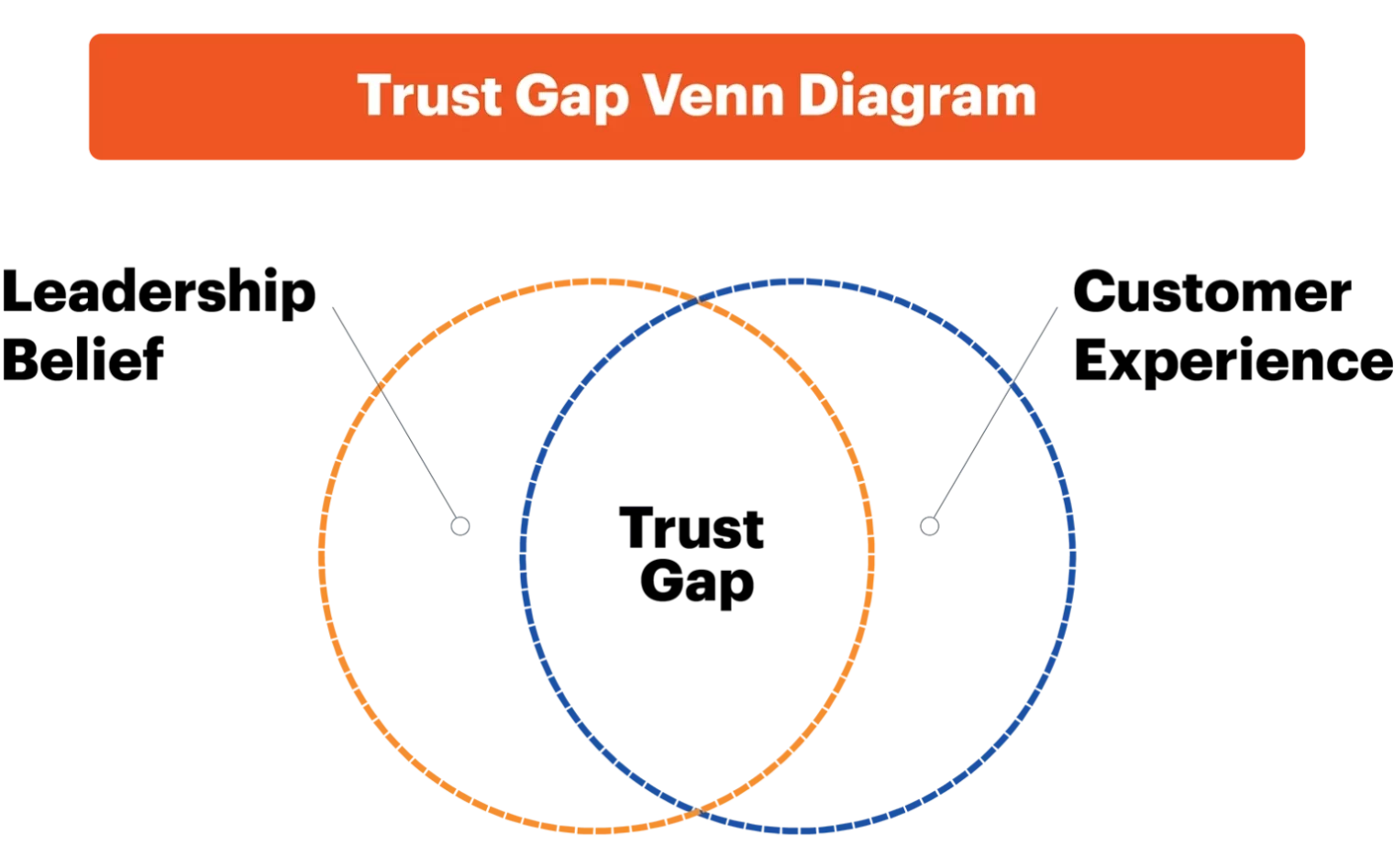
The symptoms are always visible: stagnant sales, margin pressure, loss of differentiation, internal confusion about “who we are.” But the root cause sits deeper—in the gap between what leadership believes the brand represents and what customers actually experience.

This gap grows from predictable sources:

  • Brand strategies disconnected from business realities. Marketing tells one story while operations delivers another. Product innovation moves faster than brand can keep up. The result: customers encounter inconsistency at every turn.
  • Leadership treating brand as a department instead of a discipline. When brand lives only in marketing, the rest of the organization operates without alignment. Finance makes decisions that undermine positioning. Sales overpromises. Product development ignores the core value proposition.
  • The substitution of style for substance. Redesigns driven by aesthetics rather than insight. Campaigns built on what leadership wants to say instead of what customers need to hear. Beauty without strategy is a short-lived illusion.

The truth is simple but uncomfortable: you can’t market your way out of a trust problem.

You can only solve it by addressing what’s broken at the core—by aligning your business strategy, brand promise, and product delivery into a single, coherent system that customers can believe in.

That’s not a creative challenge. It’s a leadership imperative.

Trust Gap Venn Diagram

The About-You-First Model: How Empathy Builds Trust (And Trust Builds Value)

The About-You-First approach turns a traditional approach to brand inside out. Instead of starting with what we want to say, we start with what our clients’ customers need to hear, and more importantly, what they need to feel.

It begins with empathy. Before strategy, before design, before a single word is written or sketch drawn, we listen. We seek to understand our clients’ world: their pressures, ambitions, blind spots, and opportunities. We map their ecosystem of business, brand, and product to see where alignment creates strength or where disconnection quietly undermines it.

This process is both analytical and human. We call it Strategy Before Tactics—the discipline of defining who you are, what you stand for, and why you matter before investing in execution.

What This Looks Like in Practice

Return to that manufacturing client with the “packaging problem.” When we began, they were convinced the issue was visual. But our About-You-First process revealed something different.

We started by interviewing their largest retail partners. What we heard: “We love their products, but we can’t explain to customers why they should choose one line over another. They all look and sound different. Are they the same company?”

We talked to end consumers. What we heard: “I bought this product once and loved it. But when I went back to the store, I couldn’t find it. Turns out it was there—just under a completely different brand name. I felt stupid.”

We sat with their internal teams. What we heard: “We’re all working hard, but we’re not working together. Everyone has their own priorities, their own story. Nobody knows what the ‘real’ brand is supposed to be.”

The diagnosis wasn’t packaging. It was fragmentation. And fragmentation is a trust killer.

So, we didn’t start with design. We started with architecture:

  • Business clarity: We helped leadership articulate their core value proposition and retire sub-brands that diluted rather than extended it.
  • Empathy-driven strategy: We built a brand narrative based on what customers actually valued, not what the company assumed they wanted.
  • Integrated execution: We aligned product design, brand identity, and go-to-market strategy so every touchpoint reinforced the same promise.

The result wasn’t just a more coherent brand—it was a more confident organization. Teams moved from “selling” to serving. Marketing shifted from shouting to showing. Customers felt seen, heard, and valued.

And when the company went to market for acquisition, buyers saw an organization that knew who it was and where it was going. That clarity translated directly to valuation.

That’s the About-You-First model in action: business clarity precedes creative expression. Empathy informs every strategic decision. Integration replaces isolation.

In short, brand becomes less about you and more about them. That’s when transactions evolve into transformations.

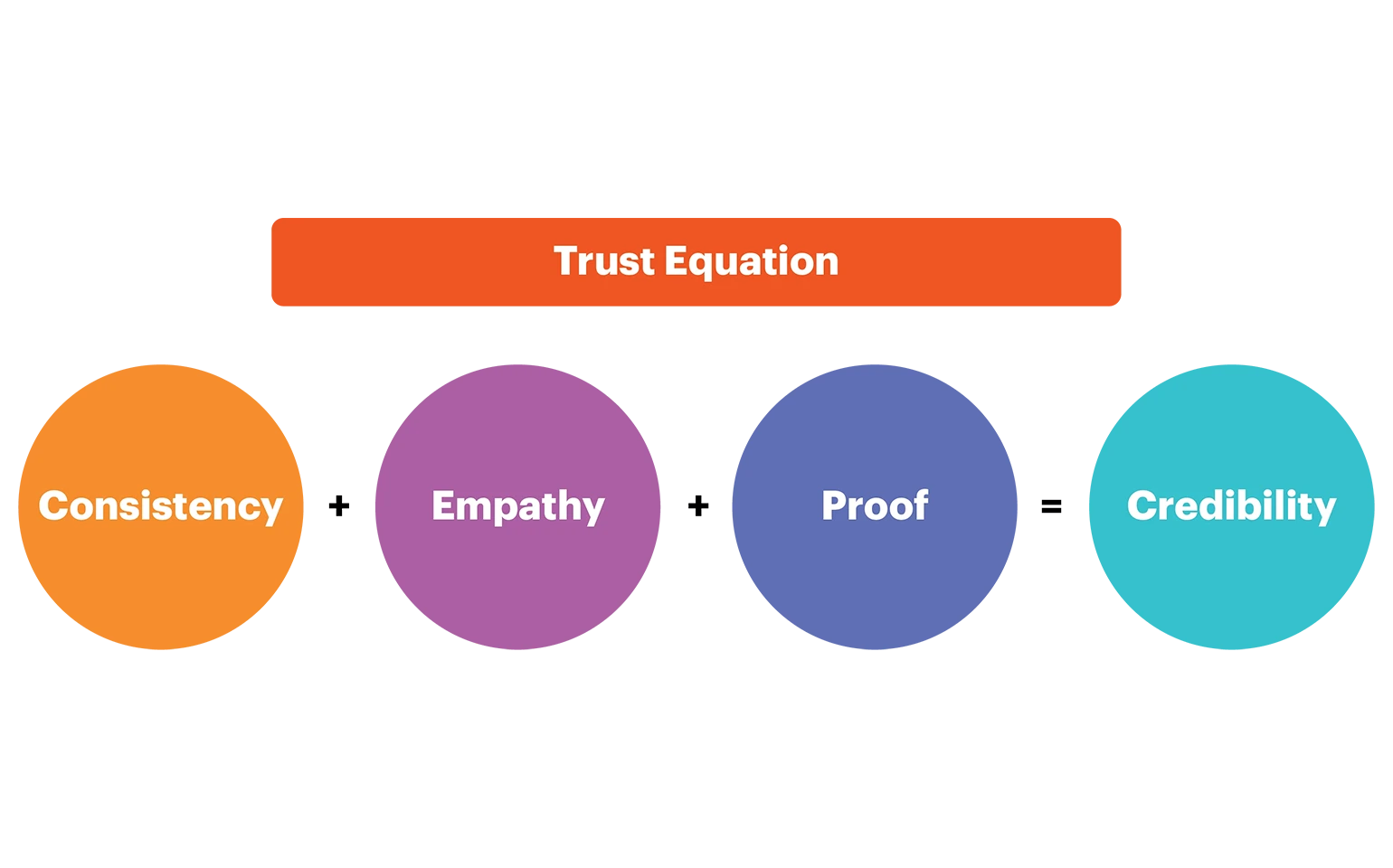
Trust Equation Consistency + Empathy + Proof = Credibility

The Trust Equation: How Authentic Connection Compounds Over Time

Trust isn’t built in a single moment. It’s accumulated through patterns—small, consistent actions that prove reliability and reinforce belief.

We call this the Trust Equation:

Consistency + Empathy + Proof = Credibility

Let’s break down each component and why it matters.

1. Consistency: The Foundation of Reliability

Consistency signals that you know who you are and what you stand for. It means your website, your product experience, your customer service, and your leadership messaging all tell the same story.

Every inconsistency—however small—introduces doubt. A customer visits your website and sees one tone of voice, then receives an email that sounds like it came from a different company. A product promises premium quality but arrives in packaging that feels cheap. Your sales team describes capabilities your operations can’t deliver.

These misalignments seem minor in isolation. But they accumulate. And in the customer’s mind, inconsistency becomes a pattern they can’t trust.

Consistency doesn’t mean rigidity. It means alignment. When your brand evolves, it evolves coherently—across all touchpoints, with intention and clarity.

2. Empathy: The Bridge to Connection

Empathy is the practice of seeing the world through your customer’s eyes. It’s asking not “What do we want to say?” but “What do they need to hear? What problems are we solving for them? What do they value? What frustrates them?”

Brands built on empathy don’t just serve customers, they understand them. They anticipate needs before they’re articulated. They design experiences that reduce friction rather than create it. They communicate in ways that respect the customer’s time, intelligence, and autonomy.

Empathy also extends internally. When leadership demonstrates empathy toward employees—listening to their challenges, valuing their insights, aligning their work with purpose—trust compounds inside the organization. And internal trust always manifests externally.

Empathy isn’t a soft skill. It’s a strategic advantage. The brands that win are the ones that understand their customers better than competitors do.

3. Proof: The Evidence of Integrity

Proof is where promises meet performance. It’s delivering what you said you would, when you said you would, at the quality you committed to. It’s follow-through. It’s reliability in action.

Proof shows up in product quality, customer service responsiveness, transparent communication, and accountability when things go wrong. It’s the accumulation of small promises kept.

Over time, proof becomes reputation. And reputation becomes your most valuable asset because it’s the one thing competitors can’t copy.

Proof isn’t perfection. Mistakes happen. But how you respond to mistakes—with honesty, accountability, and corrective action—becomes proof of character. And character builds trust faster than flawless execution ever could.

Why the Equation Matters

When you combine consistency, empathy, and proof, you create credibility—the belief that your brand means what it says and delivers what it promises.

Credibility turns customers into advocates. Advocates become evangelists. And evangelists create compounding value that no marketing budget can buy.

The irony is that while many companies chase awareness, the real differentiator is assurance. Customers already have infinite options. What they lack is certainty. They want to know you care. They want to believe you’ll show up.

Trust-centric brands outperform not because they talk more, but because they listen better. They anticipate needs, adapt quickly, and deliver consistently. Over time, that reliability becomes magnetic.

Trust, once established, becomes self-sustaining. It reduces the need for persuasion because credibility already exists in the minds and hearts of customers.

Recognizing the cracks is only the beginning. Once you can see where trust has eroded—where misalignment, inconsistency, or drift have taken hold—the real work begins. Diagnosis creates clarity, but clarity alone can’t move an organization forward. Leaders need a way to rebuild, to reorient, to navigate with intention and confidence. In other words, after understanding the problem beneath the surface, you need a compass.

In Part 2, we shift from why trust fails to how trust is designed and strengthened, exploring the practical frameworks and leadership behaviors that turn insight into action, and action into measurable value.

Let’s Start with a Conversation

For manufacturers and innovation teams navigating change, a discovery call with our team can clarify your needs—and reveal opportunities for growth.