Blog

August 4th, 2026
From Fragmented to Coherent: The Architecture of Brand Alignment
Chapter 9
There is a particular organizational moment that precedes almost every serious brand alignment engagement. Someone—usually in a senior role, usually with enough tenure to have watched the drift happen—looks at the full picture and says something they have been reluctant to say out loud.
This does not look like us anymore.
Not the logo. The whole thing. The way the product feels compared to the way the website reads. The way the sales team describes the company versus the way marketing talks about it. The brand they were five years ago versus the brand showing up in the market today.
The instinct is to call a brand agency and ask for a refresh. A brand that has lost coherence has not lost its visual appeal. It has lost its architecture. Architecture cannot be refreshed. It has to be rebuilt—from the strategy out, with a clear-eyed diagnosis of where the disconnection actually lives.
3 Places Brands Break Down
1. Strategic disconnects are invisible internally until someone asks the leadership team the same question and gets five different answers. The diagnostic question: if I asked five people on your leadership team what makes you different, would I get the same answer?
2. Behavioral disconnects are gaps between what the organization promises and what it delivers—in product quality, customer experience, or the space between the marketing narrative and the operational reality. The diagnostic question: where does the customer experience start to feel different from what marketing promises?
3. Experiential disconnects are customer-facing moments that do not reflect the same visual language, tone, or brand promise. The diagnostic question: when your customers move from the website to the product to the packaging, do they feel like they are in the same world?
In practice, most brands present with Experiential Disconnects—the visible symptoms. But they are almost always downstream of Strategic or Behavioral ones. Fixing the visual expression without addressing the underlying source produces a brand that looks coherent and feels hollow, and starts fragmenting again within eighteen months.
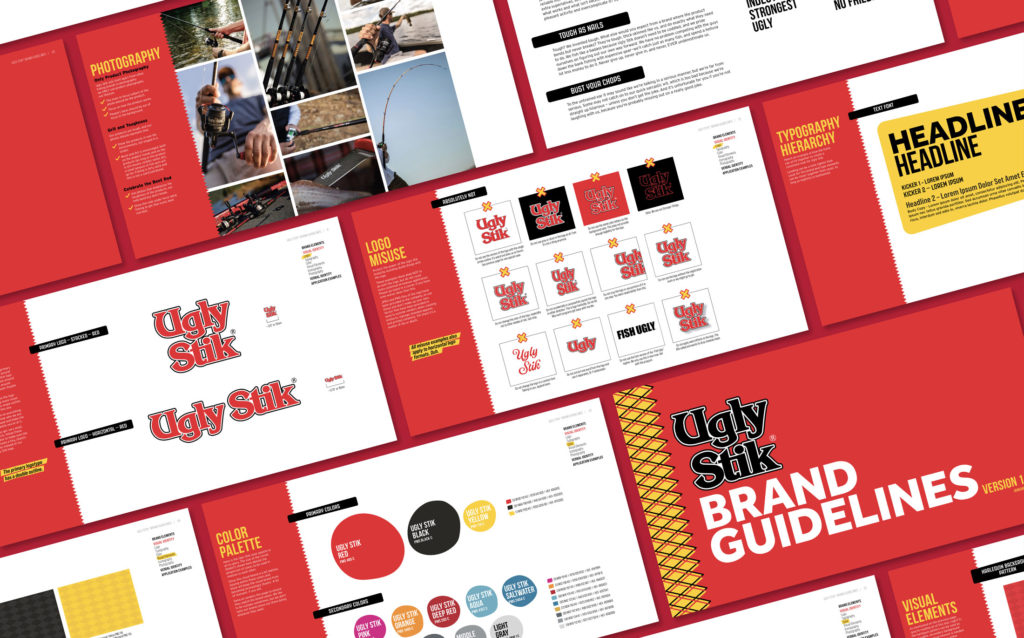
Ugly Stik: When the Equity Is the Roughness
Ugly Stik has been catching fish for over forty years. The name tells the story: a fishing rod so visually unpolished, so deliberately unbothered by refined aesthetics, that it became a badge of honor. Legendary durability. No-nonsense performance. A cult following built not on aspiration but on trust.
When Pure Fishing brought BOLTGROUP in, the presenting problem was an Experiential Disconnect—the visual and verbal identity had grown inconsistent over time. The real diagnostic revealed something more precise: Ugly Stik did not have a brand identity problem. It had a brand governance problem. The equity was intact—the toughness, the authenticity, the unapologetic personality. What was missing was the architecture to hold those qualities consistently without smoothing away the rough edges that made the brand what it was.
The goal was not to make Ugly Stik more polished. It was to make it more consistently, more deliberately, more governably ugly. To build a design language rigorous enough to express that authentic character across every touchpoint, including the ones designed by someone who has never held an Ugly Stik rod in a cold river at dawn.
| The most common brand alignment mistake is trying to make the brand more appealing when what it actually needs is to be more itself. Coherence is not about elegance. It is about integrity. |
The result was a unified, modernized brand that maintained its signature toughness while opening the door to a broader audience. The GX2 launch won the Anglers’ Choice Award at ICAST, the world’s largest sport fishing trade show. New products continued to follow—each one an expression of the same brand truth, governed by the same architecture, recognizable to anyone who has ever picked up an Ugly Stik.
NEXT IN THE SERIES
Chapter 10: Why Rebrands Fail—And What Brand Continuity Actually Requires
Brand alignment builds the architecture. Brand continuity is what keeps it standing—through product cycles, market shifts, and the accumulated pressure of an organization that is always moving. Chapter 10 is where the long game gets its full argument.