September 16th, 2026
Design as Care
I believe design is an act of care. I always have.
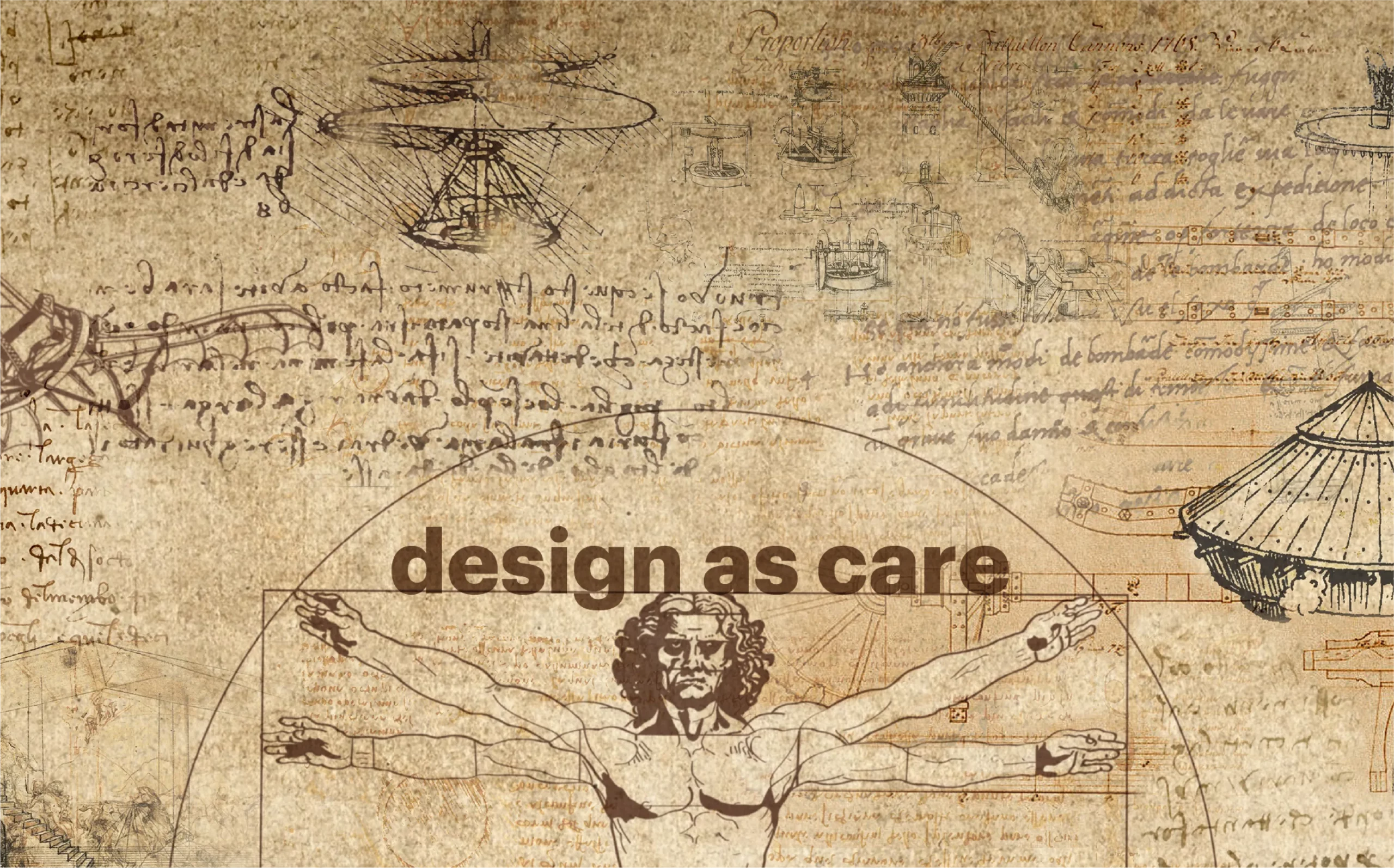
For me, it started with Leonardo. Art history gave me a basic understanding of something that’s been true for thousands of years—that a mark, its environment, its application to a product, and the feeling it gives the person holding it are not separate things. They’re intertwined. They always have been.
To earn that relationship with someone—a customer, a patient, a user, whoever’s on the other end of the work—you can’t hand them art. You can’t hand them words. You can’t hand them engineering. Any one of those alone is a fragment.
You have to hand them design. Design with thought. With meaning. With empathy. With passion.
The outcome is a culmination of giving your best self to make something—anything—better for someone else.
That’s design as care.
The Door Handle
Now, you don’t need an art history degree to know this. You’ve felt it your whole life. You know the difference between a door handle that fits your hand and one that doesn’t. Between a form that respects your time and one that punishes it. Between a hospital room built for a chart and one built for a person lying in the bed.
None of those differences show up on a spec sheet. They’re not features. Nobody put “empathy” in the requirements document. But you feel the difference instantly, and so has every human being who’s ever used anything at all.
That feeling is not an accident. It’s evidence—evidence that somebody, somewhere, either gave you their care or didn’t. And you knew which one it was without being told.
The Unfinished Sentence
That’s the part I want you to sit with, because it changes what design actually is. Form follows function—Louis Sullivan gave us that phrase over a hundred years ago, and he wasn’t wrong. He was just early. He was looking at buildings—steel, height, the honest expression of structure—and he was right that a thing should look like what it does. But he stopped one layer too soon. A building doesn’t just do something. It does something to somebody. It makes them feel small or safe, watched or welcomed, rushed or unhurried. That’s not decoration on top of function. That is the function. We’ve spent a century measuring the wrong half of the sentence.
Every object, every space, every interface any of us will ever touch was made by somebody who made a choice, in a hundred small moments, about whether to care. We just never had a word for measuring which choice they made. I’d like to give us one.
Here’s what that costs us when we get it wrong. A form can perform its mechanical job perfectly and still fail the person using it. A door can open. A latch can catch. A device can operate exactly to spec. And the person on the other end can still walk away feeling smaller than when they arrived. That’s not a bug in the design. In a very real sense, that is the design. It’s just design without care in it.
So, if function was never the whole function, we need a fuller phrase. Form follows function. Function follows feeling. Feeling follows care.
That’s the thesis. Everything I’ve built, and everything our firm has built for more than forty years, sits underneath that one idea.
The Click
Let me show you what that looks like in practice, because this isn’t theory to me. This happened recently.
We’re in a workshop with a client, solving the last piece of a device system that’s going to be genuinely game-changing. The device has to be activated by touch, by a gloved hand in a clean environment where you cannot always see clearly and you cannot afford to guess. It looked like a UI problem. It was actually a feeling problem.
The fix was small. A detent, a tiny mechanical click built into the engagement point. Nothing about it was required. The device would function exactly the same without it. But now, when it’s fully and properly engaged, your fingers feel it, and your ears hear it.
That click doesn’t do anything to the device. It does something to the user. In a sterile field, that click is the difference between wondering and knowing. It’s certainty, delivered as a feeling, at the exact moment someone needed it most.
Nobody asked for that. It’s not on a requirements list. But it’s going into the final design, because a room full of engineers and designers understood, in that moment, that function alone would have left a gap only feeling could fill.
That’s the whole idea, in one small click.
Are They Better Off?
But a belief needs more than a beautiful sentence. It needs a test. Because if feeling is the function, and care is what produces it, then we need a way to know whether we actually delivered it, or whether we just told ourselves a nice story about our own intentions.
The Greeks had a word for this, and I want to borrow it, because nothing in English does the job quite as well. Eudaimonia. It gets translated as happiness, but that’s too small a word for it, and it sells the idea short. Aristotle didn’t mean a good mood. He meant something closer to human flourishing—a life lived well, through the exercise of your own capability, toward your own good. Not a feeling that passes. A condition that lasts.
So, here’s the test I’ve come to use, and the one I’d ask you to borrow. Not “did they like it?” Liking is easy to manufacture, and it fades by dinner. The question is: are they better off? Did what we make help someone become more capable, more whole, more themselves? Or did it just occupy their attention for a while and then let them go on, no different than before.
That’s a harder bar than customer satisfaction. It’s supposed to be. A vending machine can satisfy you. It cannot help you flourish. And I’d argue most of what gets called design today is closer to the vending machine than we’d like to admit. Technically fine, emotionally forgettable, and utterly unconcerned with whether you walked away better than you arrived.
Care is the intention. Feeling is the function. Eudaimonia is how we keep ourselves honest about whether we actually delivered either one.
The Practice
So, here’s what I’d ask of you, and it costs nothing, and it will change everything.
The next time you’re asked to make something—a product, a room, an email, a meeting, doesn’t matter what—before you call it finished, ask one question. Who does this serve? And are they better off because of what I just did?
That’s the whole discipline. You don’t need my training. You don’t need my firm. You already know how to answer it; you’ve known since you were old enough to notice the difference between being handled and being cared for.
Leonardo didn’t leave us a technique. He left us a posture: that everything you make carries the truth of whether you loved the person you made it for. Four hundred years later, that’s still the only question worth asking.
Design is an act of care. I always believed it. Now I’m asking you to practice it.