Blog
July 10th, 2026
The Market Speaks and It Wants Its Story Back
Fourteen years ago, I wrote a piece for Fast Company that got under my skin more than most things I’ve put on paper. I called out American retail for a quiet conspiracy—a race to the visual bottom in which JCPenney, Belk, Sears, and Gap all reached for the same lowercase sans-serif identity as if homogenizing their logos would somehow make them more lovable to a younger customer. I ended with a warning: “In an attempt to become relevant to everyone, our retailers are becoming relevant to no one.”
I didn’t know then how long the disease would spread, or how far. I just knew what I was seeing—heritage brands voluntarily surrendering the one thing that no competitor could take from them: their own story.
Turns out I was watching the first act of a much longer play.
What Happened Next
The generalization wave didn’t stop at American retail. It went global, it went digital, and it went deep into the storied houses of British and European brand culture—the ones that had spent a century or more building the kind of provenance you simply cannot manufacture. Burberry. Gucci. Mulberry. Brands that were shorthand for an entire way of seeing the world.
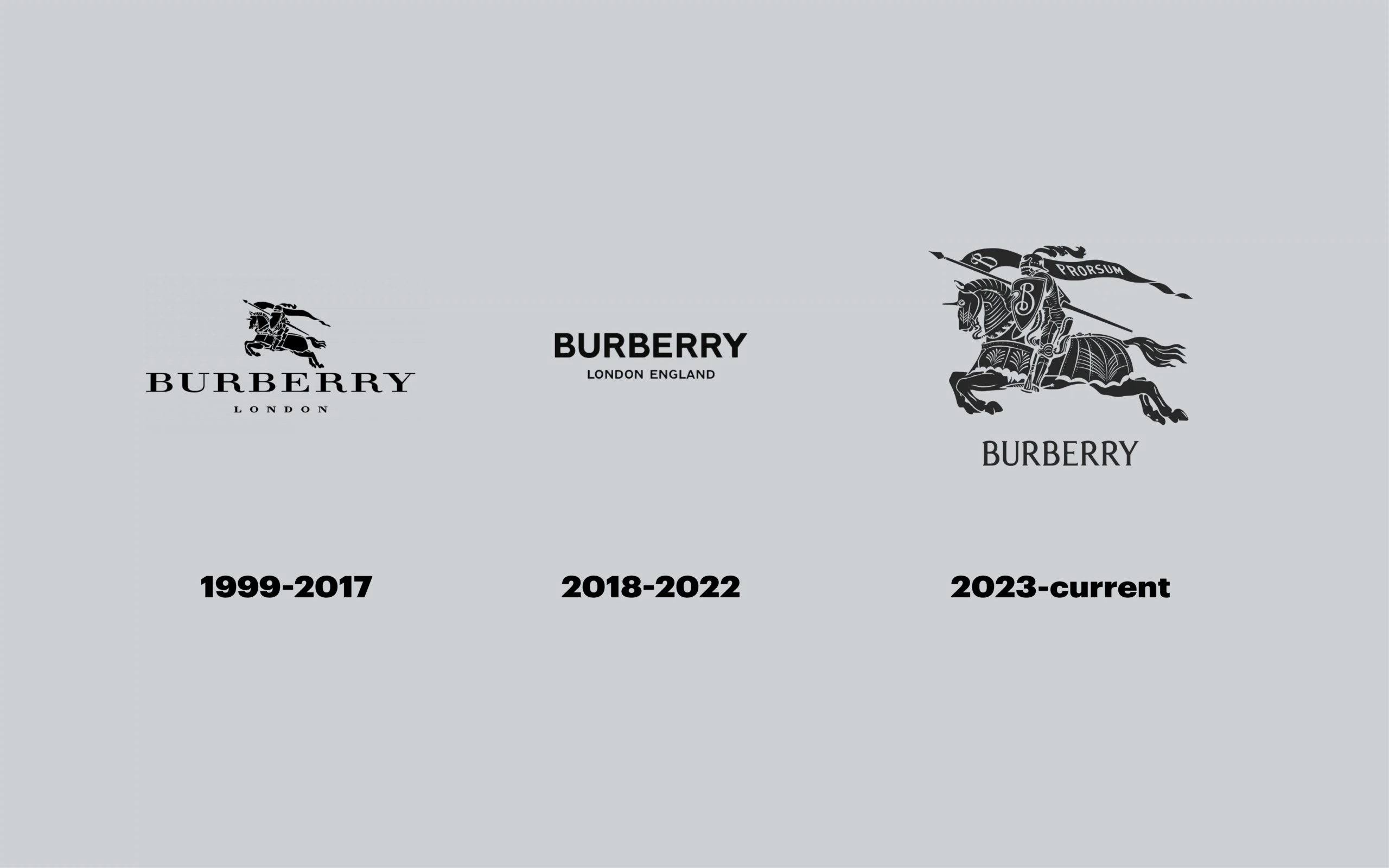
In the e-commerce decade, the logic seemed sound: broaden the appeal, flatten the identity, chase the algorithm. Add SKUs. Drop the serif. Lose the equestrian knight. Hire a superstar creative director and let their story override the house’s story. Go global by going generic.
You already know how it ended. The market—patient, implacable, occasionally brutal—eventually delivered its verdict. Bain’s 2024 luxury study put it plainly: brands need to “rediscover their essence and embrace the foundational pillars of the industry: desirability fueled by craftsmanship, creativity, and distinctive brand values.” Translation: you cannot wholesale yourself out of meaning and then wonder why nobody’s buying.
The Returns
Burberry is perhaps the most visible comeback. When Daniel Lee arrived as Chief Creative Officer in late 2022, his first act was to wipe the brand’s Instagram clean and re-emerge with a campaign that restored the 1901 equestrian knight, the motto Prorsum—Latin for “forward”—and a new typeface drawn directly from century-old archive lettering. Filmed in the rain, in London, with British icons. The message was a single note, played loud: we are going home. Lee grew up in Yorkshire near where Burberry’s trench coats are still manufactured. This was personal. This was a homecoming.
Mulberry named its recovery plan with disarming plainness: “Back to the Mulberry Spirit.” Their creative studio director described it with equal honesty: “What started out as a necessary exercise turned into a deep interrogation to recover our spirit.” Pure archaeology, and it’s working. The brand posted 5% sales growth in fiscal 2026, appointed Christopher Kane as creative director of a revived women’s ready-to-wear line, and re-entered wholesale partnerships with John Lewis, Liberty, and Harvey Nichols. Physical retail. Story first.
Barbour, which never strayed quite as far, launched its Heritage+ line in 2024 to celebrate 130 years, reissuing archive pieces with updated fits, traditional construction, tartan liners, and brass hardware. Operating profits rose 15% while turnover dipped. A conscious amplification of what was always true.
Gucci offers the cautionary note. Their post-Michele reset toward clean minimalism failed to resonate, and by late 2024 sales had fallen 25% year-over-year in key markets. Stripping a heritage brand to its bones and calling it refinement is a different act entirely from returning to its soul. Peeling back the excess is not the same as peeling back the identity.
And then there’s Jaguar—the case study nobody wanted to become. In November 2024, the brand retired the iconic leaping cat, launched a campaign that didn’t show a single car, and invited the world to “Delete Ordinary.” By April 2025, European sales had dropped 97.5% year-over-year. The design chief was fired. A nine-month global agency search followed. Jaguar spent nearly a century building the meaning of that leaping cat, then spent eighteen months explaining why they didn’t need it. The market responded the way markets always do to that kind of argument.
The Cracker Barrel Debacle
If all of the above feels like a European problem, allow me to bring it home.
In August 2025, Cracker Barrel unveiled a $700 million brand refresh. The centerpiece: a new logo that removed the beloved “Old Timer”—the Uncle Herschel silhouette anchoring the brand’s identity for decades—replacing it with a clean barrel outline and a text-only wordmark. “Old Country Store” was gone too. The rationale was eminently sensible: improve billboard legibility, modernize the visual system, reach a broader customer.
The market responded with swift fury. The stock fell 7% in a single day. Social media erupted. A sitting president publicly weighed in. Within eight days, Cracker Barrel issued a statement—“We could’ve done a better job sharing who we are and who we’ll always be”—and scrapped the new logo entirely, restoring the Old Timer.
Eight days. $700 million investment. Gone.
The diagnosis was accurate. The surgery was botched. What the Cracker Barrel team missed—what so many brand teams miss—is that their customers hold the logo because it holds them. The Old Timer is a promise made visual: walk through that door and you know exactly where you are, and it feels like somewhere you belong. Honor the promise first. Build thoughtfully around it.
A Brand That Never Needed a Comeback
While all of these brands were losing and recovering their souls, one American brand was quietly doing what it has always done. Since 1752.
Caswell-Massey, America’s original apothecary, was founded in Newport, Rhode Island by a Scottish-born physician named Dr. William Hunter. The brand is regarded as the fourth-oldest continuously operating company in America and the oldest American consumer brand in operation, with loyal customers across four different centuries, including George Washington, Greta Garbo, JFK, and the Rolling Stones.
Their signature Number Six cologne was created in 1772 from a handwritten recipe still held in the Caswell-Massey archives. When they modernized in 2017, updating the website, social media, and packaging, they kept the formulas as close as possible to the original recipes. They stewarded.
“We are only the stewards of this great American brand, carrying it forward into the future for the next three centuries.” — Caswell-Massey
That’s the sentence every brand manager in America should print out and tape to their wall. The question isn’t “how do we stay relevant?” The better question is “how do we carry this forward?” The orientation changes everything. The results, 273 years in, speak for themselves.
Pan Am: A Brand That Wouldn’t Die
And then there is Pan Am, perhaps the most remarkable signal of all.
An airline that ceased operations in 1991. Bankrupt. Gone. Three subsequent revival attempts, all failed. And yet the brand never really died, because the story never died. The globe. The blue and white. The Clipper. The idea that flying somewhere could be an act of aspiration rather than an act of endurance.
In June 2025, Pan Am returned to the skies: all-business-class charter flights tracing the original transatlantic routes, tickets at $65,000 a seat. By October 2025, the brand had begun FAA certification for a full commercial relaunch, with Pan Am hotels, airport lounges, and restaurants in development. The new ownership credited part of Pan Am’s ongoing resonance to younger generations drawn to things that are “retro or vintage”—people who never flew Pan Am but somehow miss it anyway.
Consider what it means that a brand dead for thirty-four years carries more cultural gravity than most brands that are alive today. Pan Am is a proof of concept: a story well-told outlasts any balance sheet.
What This Means for Your Brand
Here’s the question I’d ask any CEO who’s gone through a rebrand in the last decade, or who’s considering one now:
Did you leave the building before you knew what was in it?
The brands winning this moment excavated their story, dusted it off, and held it up to the light. Burberry’s trench coat. Mulberry’s Somerset leather. Barbour’s waxed cotton. Caswell-Massey’s handwritten recipes. Pan Am’s globe. Cracker Barrel’s old-timer on the porch. These are the load-bearing walls.
You can renovate around a load-bearing wall. Remove it, and the house falls.
At BOLTGROUP, we spend a lot of time helping clients understand the difference between modernizing a brand and abandoning one. They feel surprisingly similar in a conference room. They feel very different in the market. The brands that get it right treat their history as the foundation of a forward-looking proposition. Heritage is what you build from.
I wrote in 2011 that brands becoming relevant to everyone were becoming relevant to no one. Fourteen years later, the market has proven the thesis—loudly, expensively, and in some cases irreversibly.
The brands that listened to their own story? They’re the ones still being heard.