Blog
June 23rd, 2026
What Really Happens to a Brand in an Acquisition
Chapter 3
The press release is always the same. Strategic acquisition. Complementary capabilities. Significant synergies. And then, somewhere in the first ninety days, a VP of Marketing opens a product catalog and realizes that two companies now share a sales force, a set of distributor relationships, and a retailer who wants to know what the combined brand is going to look like on the shelf.
Nobody planned for that conversation. Nobody budgeted for it. The business case for the deal was airtight. The brand case was never part of the negotiation.
The instinct at that point is to move fast—consolidate the packaging, unify the color system, and get something coherent in front of the trade before the next show. That instinct is usually wrong.
The brands that move fastest in the wrong direction pay the highest price in lost equity and confused customers. Getting the brand in an acquisition right requires slowing down long enough to ask a question most deal teams never put on the agenda: which scenario are we actually in?
The 4 Scenarios
Every post-acquisition brand situation falls into one of four categories.
1. Absorb—the acquired brand is retired and its equity transfers to the parent.
2. Co-exist—both brands remain active and independent, each requiring a clear architecture to prevent cannibalization.
3. Federate—the acquired brand operates as a sub-brand or endorsed brand within the parent portfolio, distinct enough to hold its category credibility, unified enough to deliver on the parent’s promise.
4. Unify—two brands become one new thing that neither company was before.
| The brands that get acquisition right are the ones that slow down long enough to ask the right questions before they make a single design decision. The brands that get it wrong are the ones that answer the visual question before they have answered the strategic one. |
The Myers Industries Proof
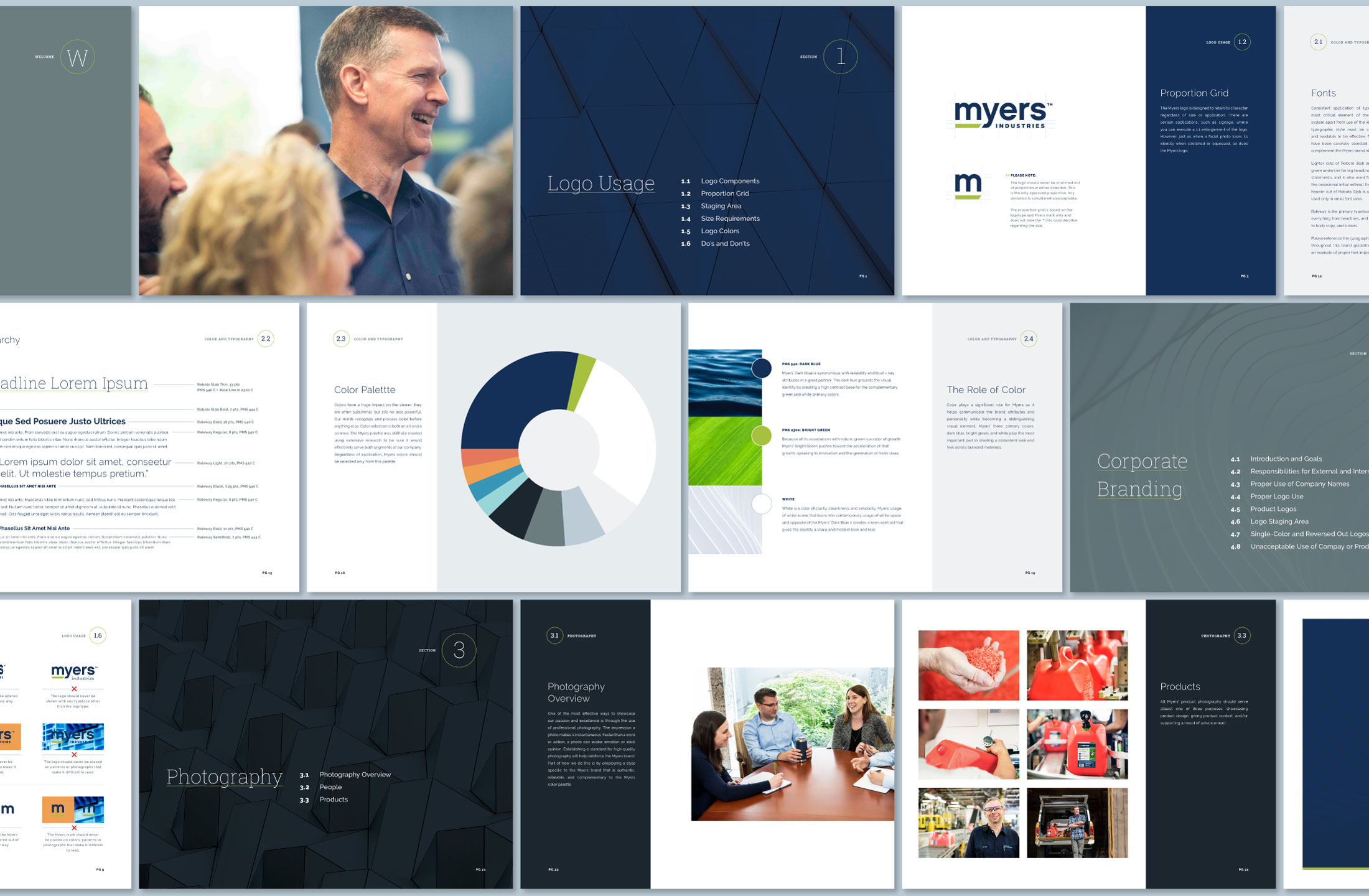
Myers Industries had not looked seriously at its corporate identity since 1963. The company was acquiring new businesses, moving toward a new market position, and chasing a long-term vision to transform its material handling segment into a high-growth innovator of engineered plastic solutions. The brand—frozen six decades in the past—could not carry that story. The internal transformation they called ‘One Myers’ had no visual or verbal language to live in.
BOLTGROUP spent thirty months building that language. A complete new corporate brand visual and verbal identity system. Environmental design for the new headquarters. A brand field guide that could onboard employees and communicate the transformation to every stakeholder—internal and external. With all new identifiers and colorways projecting the confidence of the company’s future-state aspirations, a clean and measured identity system was developed to grow as the culture transformed.
“Your approach was very thoughtful and deliberate and resulted in a very modern brand and brand identity that perfectly aligns with our One Myers culture and strategy. We’re thrilled.”
— Monica Vinay, VP Investor Relations & Treasurer, Myers Industries
Myers generated double-digit sales growth in each of the seven quarters following the brand launch. They executed and integrated the strategic acquisitions of Elkhart and Trilogy, plus an additional manufacturing facility. A brand that had been a constraint on growth became the engine of a transformation.
Design is the connective tissue that makes a business transformation visible, believable, and sustainable—for customers, for distribution partners, for the market, and for the people inside the building who have to believe in it before anyone else does. The acquisition that gets brand right does not just integrate two companies. It builds something neither company was capable of alone.
NEXT IN THE SERIES
Chapter 4: The Packaging Problem Is Never Just the Packaging
Acquisition creates brand problems at the portfolio level. There is an earlier version of the same misdiagnosis that happens at the product level every day—and it starts with a packaging brief that is solving the wrong problem.